

Wednesday, 15 April 2026
Day 2 Keynote

Dr. Jim Hileman, Chief Engineer and Vice President of Sustainability and Future Mobility, The Boeing Company
Dr. James Hileman is vice president and chief engineer of Sustainability and Future Mobility at The Boeing Company, where he leads technology development in efficiency, energy and operations to advance safe and sustainable global air transportation. His work includes initiatives in advanced aircraft design, alternative aviation energy sources, operational improvements, and the development of analytical tools such as Cascade.
Before joining Boeing, he served as the Federal Aviation Administration’s chief scientific and technical adviser for environment and energy, overseeing the agency’s research portfolio, including programs such as CLEEN, ASCENT and CAAFI. He has also played a key role in international aviation policy through leadership positions within the International Civil Aviation Organization’s Committee on Aviation Environmental Protection, contributing to global standards for noise, emissions and carbon reduction.
Earlier in his career, he was a principal research engineer at MIT, where he focused on alternative fuels and innovative aircraft concepts and contributed to major initiatives such as PARTNER and the Silent Aircraft Initiative. He holds a Bachelor of Science, Master of Science and doctorate in mechanical engineering from The Ohio State University and is an associate fellow of the American Institute of Aeronautics and Astronautics.
Plenary III: Pilots’ and Controllers’ Perspectives on Surveillance Resilience
Moderator
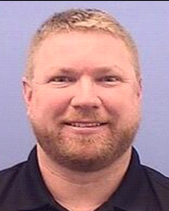
Mr. Greg Orrell, Lead Systems Engineer, MITRE
Greg Orrell has worked at MITRE for 16 years, focusing on surveillance systems and applications. Most recently, he has supported the Federal Aviation Administration in planning the Surveillance Architecture Evolution Plan, with a focus on surveillance resilience, and in prioritizing radar modernization actions as part of the Brand New Air Traffic Control System. He has also led concept maturation for the Aircraft-to-Everything Surveillance Link for unmanned aircraft systems and advanced air mobility for the FAA. In addition, he has supported the development of robust cybersecurity profiles and overlays for civil and public unmanned aircraft systems in the United States.
Earlier in his career, he worked on surveillance and unmanned aircraft systems, services and applications across the Federal Aviation Administration, Department of Homeland Security and Department of War. He holds a master’s degree in human factors and systems engineering from Embry-Riddle Aeronautical University.
Panelists
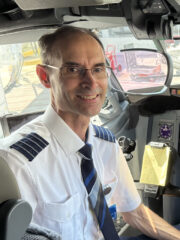
Capt. Paul Harrison, Technical Pilot – Surveillance/Datacom, Alaska & Hawaiian Airlines
Capt. Paul Harrison has been a military and airline pilot for 40 years. He has served as a technical pilot specializing in surveillance and data communications for the past 15 years. He regularly participates in industry CNS groups, including the FAA’s Performance-based Aviation Rulemaking Committee (PARC) Navigation and Communications Working Groups and the Data Comm Implementation Team. He notably participated in RTCA Special Committee 186 Working Group 4, where operational requirements were written for ADS-B In. One of his key achievements was helping plan and fly in the successful FAA-sponsored paired-approach demonstration at San Francisco International Airport in 2017. That demonstration showed how ADS-B In could be used to help address the chronic weather-related delays that occur at the airport.

Ms. Nicki Harricharan, Operations Program Manager, CANSO
Nicki Harricharan is operations program manager at CANSO (Civil Air Navigation Services Organisation), where she leads and moderates international initiatives focused on the future of air traffic management. Her work includes collaboration with global partners such as the International Civil Aviation Organization and the International Air Transport Association to address operational challenges, improve safety and integrate new airspace users.
She manages the Operations Standing Committee and coordinates workgroups that develop global best practices for air navigation service providers. Her work focuses on the safe integration of diverse airspace users, including space-based technologies and advanced air mobility. She also represents CANSO at major regional workshops and moderates panels that support and mentor the next generation of aviation professionals.
Before joining CANSO in 2024, Harricharan spent 16 years with the Federal Aviation Administration. She served as an air traffic controller at the Washington Air Route Traffic Control Center and as a front-line manager at the New York Air Route Traffic Control Center. She later worked as a national traffic management specialist in the Federal Aviation Administration Command Center’s Severe Weather Unit, managing traffic flow during severe weather events, presidential movements and rocket launches.

Capt. Edward Conant, Flight Test Operations Captain, United Airlines
Capt. Edward Conant is a seasoned aviation and defense professional with more than 30 years of experience as a senior leader, operational fighter pilot, experimental test pilot and project manager across organizations ranging from small teams to large-scale enterprises. As a flight test operations captain for United Airlines, he has flown the Boeing 777, 737 and Airbus A320, bringing extensive expertise in flight operations and testing.
His program management experience was developed during active-duty military service, including key roles within the F-35 Program Office and U.S. Air Force acquisition staff. He holds a Project Management Professional certification and Level III certifications in program management and test and evaluation from the Defense Acquisition University.

Mr. Josh Haviland, National Airspace Representative, NATCA
Josh Haviland is an experienced air traffic controller with more than 25 years of expertise. He currently serves as national airspace representative for the National Air Traffic Controllers Association, where he leads collaboration with the Federal Aviation Administration on strategic and technical initiatives, including the Airspace Modernization Roadmap, Established on Required Navigation Performance and Multiple Airport Route Separation.
Earlier in his career, he served as performance-based navigation co-lead for the Federal Aviation Administration’s Western Service Area, where he applied technical expertise and facilitated workgroups focused on designing instrument flight procedures. He later served as national co-lead for the Metroplex program through its conclusion in 2022.
Haviland began his career as an air traffic controller in the United States Navy before transitioning to the Federal Aviation Administration Contract Tower Program. He holds a Federal Aviation Administration commercial pilot certificate and is a certified flight instructor for instrument airplane. He is also a recipient of the National Air Traffic Controllers Association Archie League Medal of Safety Award.

Mr. Dan Hicok, Assistant Vice President of Air Traffic Management Solutions, NAV Canada
Dan Hicok is assistant vice president of air traffic management solutions at NAV Canada. He is responsible for all air traffic management software, systems and services at NAV Canada, including domestic and oceanic automation, tower systems, and operational air traffic information management.
Hicok joined NAV Canada after nearly 30 years with the Federal Aviation Administration. Most recently, he served as vice president of the Federal Aviation Administration’s Program Management Organization, where he oversaw acquisition of communications, navigation, surveillance and air traffic management systems and services for the agency.
Earlier, he served in several leadership roles, including deputy vice president. He also served as director of strategy, where he developed strategic vision for the integration of advanced air mobility and high-altitude airspace users into U.S. airspace and led collaboration with SESAR on advanced technology research. He earned a Bachelor of Science in aerospace engineering and a Master of Science in electrical engineering from Virginia Tech.
Plenary IV: Trajectory-Based Operations (TBO)
Moderator

Mr. Gabriele Enea, Assistant Group Leader, Air Traffic Control and Weather Systems Group, MIT Lincoln Laboratory
Gabriele Enea is an assistant group leader in the Air Traffic Control and Weather Systems Group at MIT Lincoln Laboratory. The group develops advanced technologies to enhance the safety and efficiency of air transportation.
Before joining MIT Lincoln Laboratory, Enea worked at the Center for Advanced Aviation System Development at the MITRE Corporation and in industry with Engility Corp. He earned bachelor’s and master’s degrees in aeronautical engineering and a doctorate in transportation engineering from the University of Palermo in Italy. He also earned a master’s degree in transportation engineering from Virginia Tech.
Enea is an Associate Fellow of the American Institute of Aeronautics and Astronautics (AIAA) and chair of the AIAA Aircraft Operations Technical Committee.
Panelists

Mr. Tobias Finck, Business Manager and FCA Project Lead (SESAR3), German Aerospace Center (DLR)
Tobias Finck has served as business manager at the German Aerospace Center since September 2024. Since June 2023, he has also led the Flight Centric ATC project within the SESAR3 program. His current work focuses on a European Civil Aviation Conference-wide Flight Centric ATC concept.
Since joining the German Aerospace Center’s Institute of Flight Guidance in 2016 as a researcher, he has developed and validated a Flight Centric ATC concept for Hungarian airspace under SESAR2020, serving as deputy solution lead, exercise lead and document lead for several deliverables, including the validation plan and report. Finck holds a master’s degree in aeronautics and astronautics from the Technical University of Berlin.

Dr. Stéphane Mondoloni, Director, Transportation Evolution and Engineering Division, MITRE
Dr. Stéphane Mondoloni is director of the Transportation Evolution and Engineering Division at the MITRE Corp. In this role, he leads a team dedicated to modernizing communications, navigation, surveillance and automation systems toward an information-centric vision of the National Airspace System.
He has conducted research in air traffic management for more than 20 years and has authored more than 50 technical publications and future concepts. His research interests include air traffic management simulation, optimization, and operational performance evaluation and improvement. For more than 15 years, he has advised ICAO expert groups on visionary air traffic management concepts, including trajectory-based operations and Flight and Flow Information for a Collaborative Environment. He has collaborated with global partners to develop, validate and mature these concepts, from authoring operational concepts to real-world operational demonstrations.
Dr. Mondoloni received a doctorate from MIT in aeronautical engineering and an MBA from IESE Business School. He is a fellow of the Royal Aeronautical Society and an associate fellow of the American Institute of Aeronautics and Astronautics.s

Ms. Sherry Yang, Senior Manager, Airspace Operational Efficiency, The Boeing Company
Sherry Yang is senior manager of Airspace Operational Efficiency at Boeing Engineering & Technology Innovation (E&TI). She is responsible for executing AOE’s missions and collaborating with government agencies and industry partners to advance airspace operations in trajectory-based operations (TBO), artificial intelligence and machine learning (AI/ML), air traffic management (ATM) and advanced air mobility (AAM). Working across technologies and businesses, Yang facilitates public- and private-sector partnerships to develop and evaluate new technologies and operational concepts for the aviation ecosystem.
She is an Associate Fellow of the American Institute of Aeronautics and Astronautics (AIAA), a technical advisor to the International Civil Aviation Organization’s Air Traffic Management Requirements and Performance Panel (ATMRPP) and Information Management Panel (IMP), and co-chair of CANSO TBO Readiness Task Force.
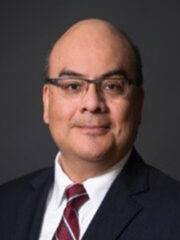
Mr. Will Estrada, Senior Director and ATM Product Manager, Leidos
Will Estrada is senior director and ATM product manager at Leidos, bringing more than 35 years of experience advancing air traffic management capabilities across the global aviation community. He provides operational and technical insight into the challenges, trade-offs and opportunities air navigation service providers face as they transition legacy ATM environments to meet evolving future demands.
At Leidos, he leads the evolution of the SkyLine ATM product suite, working closely with ANSP partners to modernize ATM capabilities through collaboration, co-development and long-term partnerships. His approach focuses on delivering flexible, future-ready solutions that balance innovation, operational resilience and sustainable growth.
Before joining Leidos, Estrada held senior leadership roles at NAV CANADA, where he played a key role in delivering industry-first innovations, including internet flight planning, SATVOICE and space-based ADS-B. For his contributions to space-based ADS-B, he received a bronze medal from the Royal Aeronautical Society.

Mr. Philippe Masson, ATM Program Manager, Airbus
Philippe Masson is an ATM program manager at Airbus, optimizing flight operations and supporting the introduction of aircraft solutions and innovations into operations. He has an air traffic management background, having worked in program lead and technical director positions for military and civil ATM system development for more than 20 years.
He has been especially engaged in datalink capabilities deployment, 4D trajectory management, ATM conflict detection and resolution, UTM/U-space definition, and sustainability initiatives including formation flying and non-CO2 operational mitigation, as well as enabling weather services. He builds large consortiums and stakeholder alignments, particularly within the SESAR program.
ICNS Champion Award
11:50- 12:00
Networking and Lunch
12:00 – 13:00
Technical Program
Evening Networking Event
17:30 – 20:00
ICNS 2026 Sponsors
Thank you to this year’s sponsors. Your financial support is crucial to the success of the conference and we thank you for this.
Platinum

Gold






Silver

Exhibitor